Naghash Hovnatan
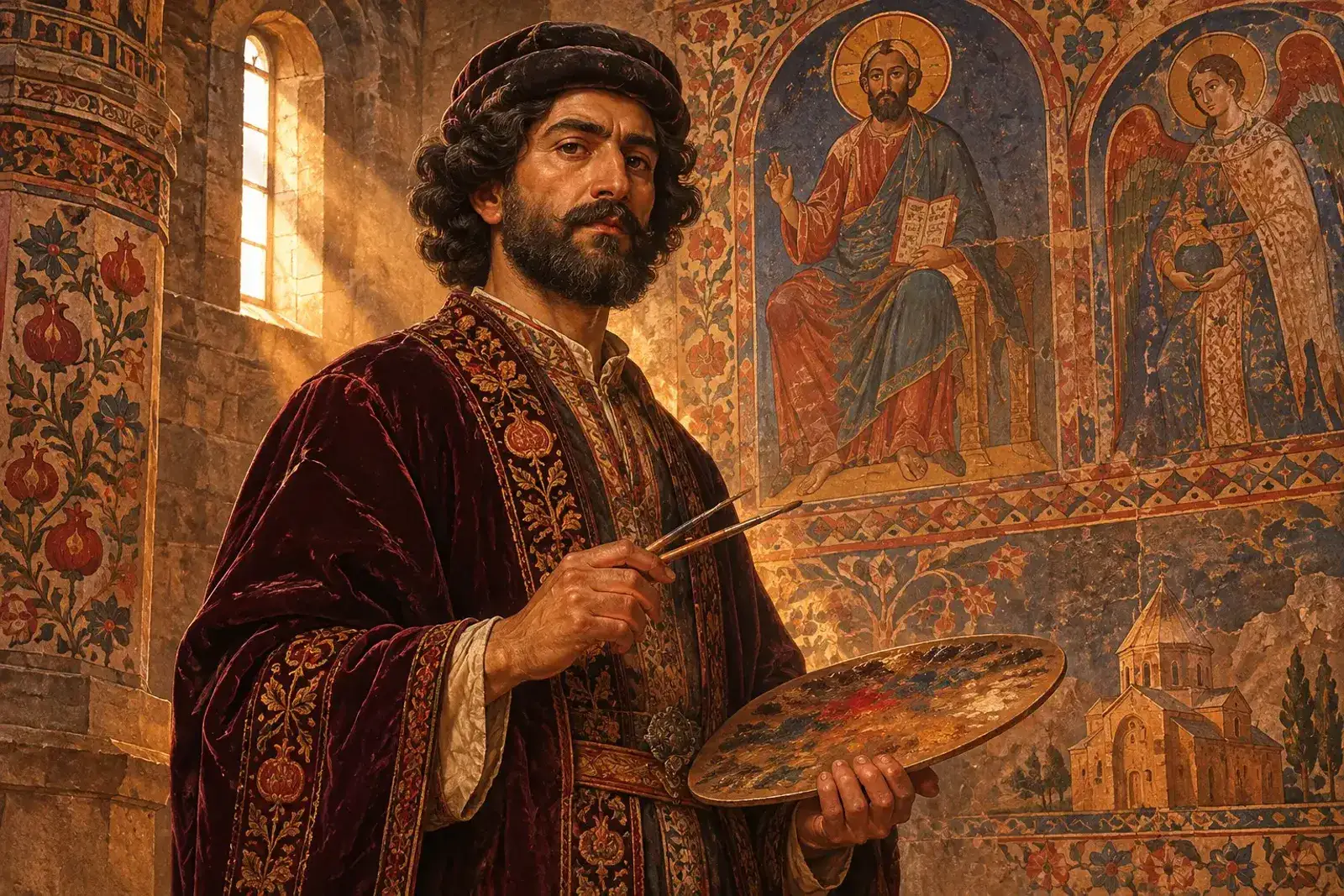
An Armenian poet, ashik, painter, muralist, and founder of the Hovnatanian artistic dynasty, whose given name was Hovnatan, while the moniker Naghash was bestowed upon him for his mastery as a painter. He was born in 1661 in the village of Shorot in the Goghtn district into the family of Priest Hovhannes. He received his primary education and initial training in calligraphy and painting under his father's guidance, and subsequently continued his studies at the monastic school of Saint Thomas the Apostle in Agulis. Throughout his creative career, he lived and worked in Goghtn, Yerevan, Tiflis, and Holy Etchmiadzin. As an artist, Naghash Hovnatan played a pivotal role in the evolution of Armenian fine arts by merging the traditions of medieval manuscript illumination and mural painting with secular realistic elements. He decorated numerous churches in Shorot, Agulis, and Yerevan, including the Yerevan churches of Saints Peter and Paul, Saint Ananias, Holy Mother of God Katoghike, and Saint Zoravor. In the 1710s, he was invited to Tiflis to serve as court painter and singer-ashik to King Vakhtang the Sixth of Kartli, and in 1720 and 1721, at the invitation of Catholicos of All Armenians Astvatsatur the First Hamadantsi, he executed the interior frescoes and decorative ornaments of the Mother Cathedral of Holy Etchmiadzin. His artistic school was carried forward and expanded by his sons and grandsons. In literature, Naghash Hovnatan stands as a bridging figure connecting medieval