Gurzadyan-Penrose Hypothesis
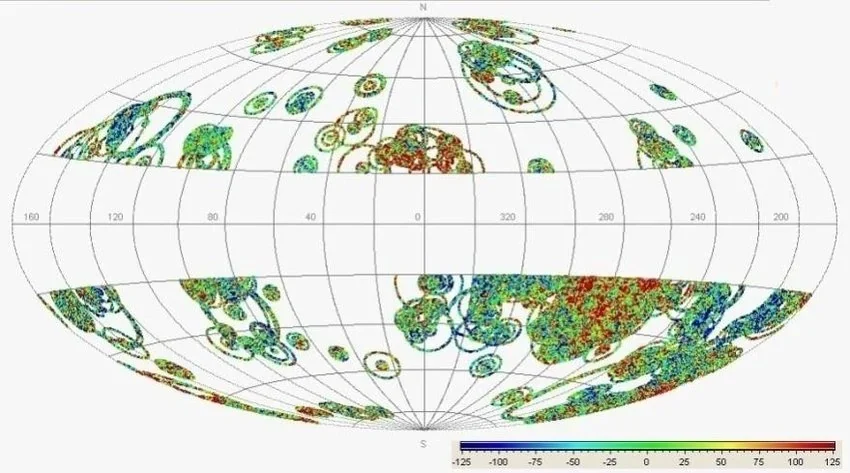
The Gurzadyan-Penrose hypothesis, more widely known in global science as Conformal Cyclic Cosmology, is a fundamental theory of the origin and evolution of the Universe that offers a novel perspective on the infinity of cosmic development. This theory was formulated and substantiated with observational evidence by eminent British theoretical physicist and Nobel laureate Roger Penrose alongside renowned Armenian astrophysicist Vahagn Gurzadyan. The core idea of the hypothesis is that our observable Universe is neither the only one nor the first, but rather iterates through an infinite sequence of cycles called aeons, where the end of a preceding cosmic epoch becomes the Big Bang beginning of the next. The theoretical foundation of Conformal Cyclic Cosmology rests upon the mathematical framework of general relativity and the principles of conformal geometry. According to this concept, each aeon begins with a Big Bang and undergoes accelerating expansion driven by dark energy. In the distant future, once all stars have burned out and supermassive black holes have evaporated via Hawking radiation, only massless particles such as photons and gravitons remain in the Universe. In this state, the Universe loses its sense of temporal and spatial scale, mathematically allowing the infinitely expanded future boundary of a previous aeon to be smoothly matched via conformal rescaling to the Big Bang initial state of the subsequent aeon. A decisive role in the observational substantiation